


In 1474, a girl was born in Ferrara, Italy, who would grow up to become one of the most extraordinary women in European history. According to court records, she was praised for her grace and intelligence before she was old enough to read. By her twenties, she was one of the most powerful women on the Italian peninsula. By her forties, popes wrote to her for counsel. By the time she died, poets and statesmen across Europe paid tribute to a woman who had lived, by every measure, a life of beauty, abundance, and extraordinary self-determination.
Her name was Isabella d’Este, Marquise of Mantova. And she is still remembered today as the First Lady of the Italian Renaissance.
Most people have never heard of her. That’s a shame — because Isabella understood something about the relationship between beauty, identity, and personal power that our world has almost entirely lost.
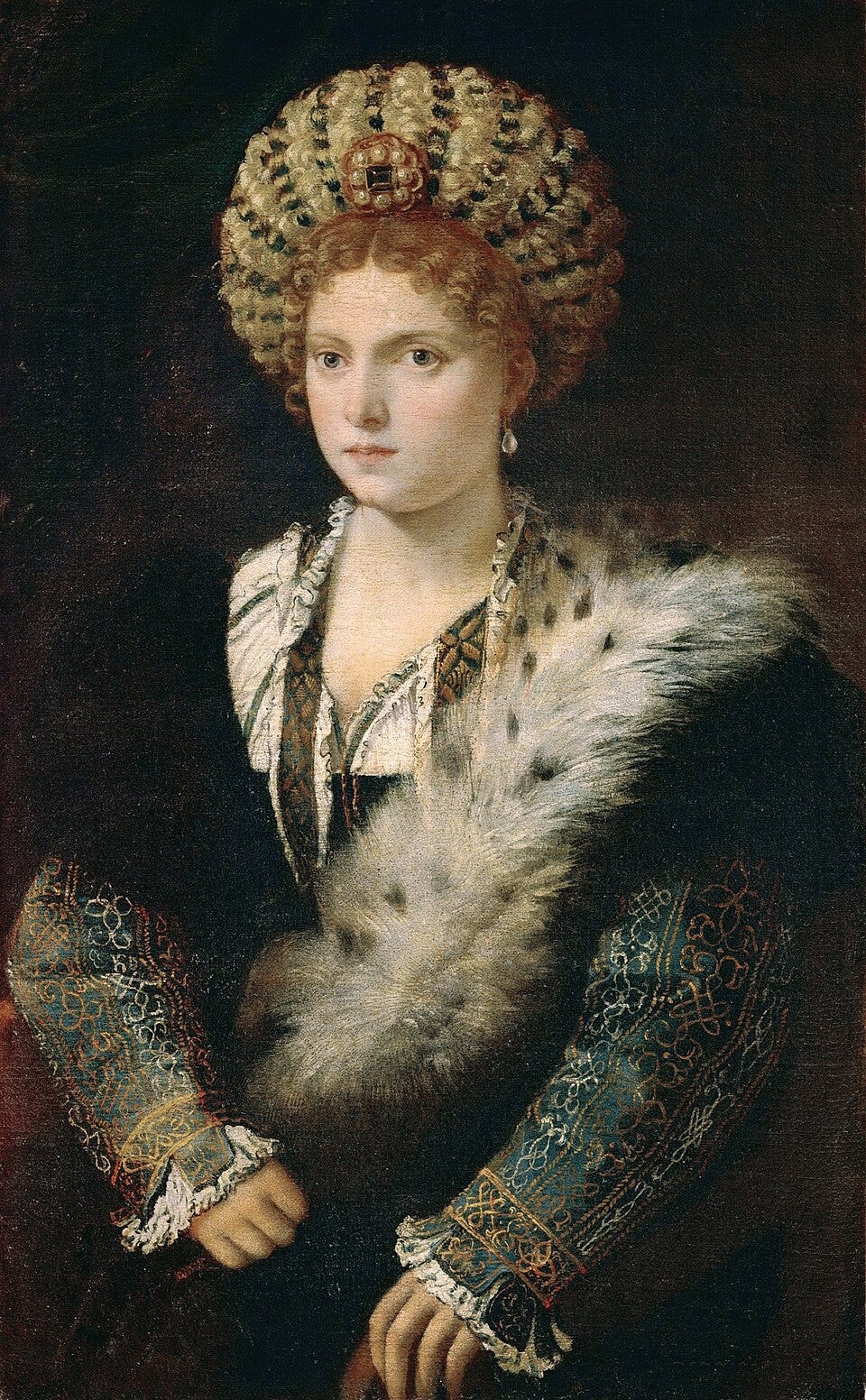
Not a muse. A creator.
The Renaissance is full of celebrated men — Leonardo, Michelangelo, Raphael, the Medici — and the women of the era are usually remembered as muses, patrons at best. Isabella d’Este was neither. She was a protagonist.
Born into the House of Este, one of the oldest ruling families in Europe, she was raised in the court of Ferrara, surrounded by scholars, artists, and thinkers. Her father, Duke Ercole I, ensured that she received an education that most men of the era would envy — classical languages, philosophy, music, the arts. But what made Isabella exceptional was not her education alone. It was what she did with it.
From a young age, Isabella understood something that most people never grasp: that beauty is not decoration. It is a force. It is a tool. And when deliberately cultivated, it becomes the most powerful instrument a person has for shaping their reality.
She didn’t just collect art. She commissioned it with specific intention — choosing subjects, directing compositions, demanding revisions until the work aligned with her vision. She didn’t just furnish her rooms. She designed them as extensions of her identity — each space a deliberate expression of who she was and who she intended to become. She didn’t just dress well. She invented fashion, sending precise instructions to her tailors, creating styles that were copied across the courts of Europe.
Everything in Isabella’s life was chosen with purpose. Nothing was accidental. Nothing was merely trendy.
She was, in the truest sense of the word, a deliberate designer of her own existence.
The pursuit of a single, coherent knowledge
What set Isabella apart from other powerful women of her time — and there were several — was not just her taste or her political acumen. It was the depth of her intellectual project.
Isabella was connected to the Neoplatonic Academy in Florence — the extraordinary circle of artists, philosophers, and scholars that had formed around Cosimo de’ Medici and later flourished under Lorenzo the Magnificent. These thinkers were devoted to a radical idea: that a human being could shape his life the way an artist creates a work of art, directing it consciously toward beauty and evolution.
This was not a metaphor for them. It was a practice. They believed — based on their study of ancient texts recovered from Byzantium and Egypt — that beauty, understood as harmony and perfection, was the highest form of energy in the Universe. That it had the power to elevate human consciousness. That it was, in fact, a bridge between the human and the divine.
Isabella pursued this idea with an intensity that defined her entire life. She sought what the Neoplatonists had sought before her: a single, coherent knowledge that unified all the disciplines of human learning — philosophy, art, science, architecture, the understanding of human nature itself. She studied under masters. She corresponded with the leading minds of her era. She spent decades researching, testing, and applying what she learned.
And she applied it not to a canvas or a manuscript — but to the design of her life.
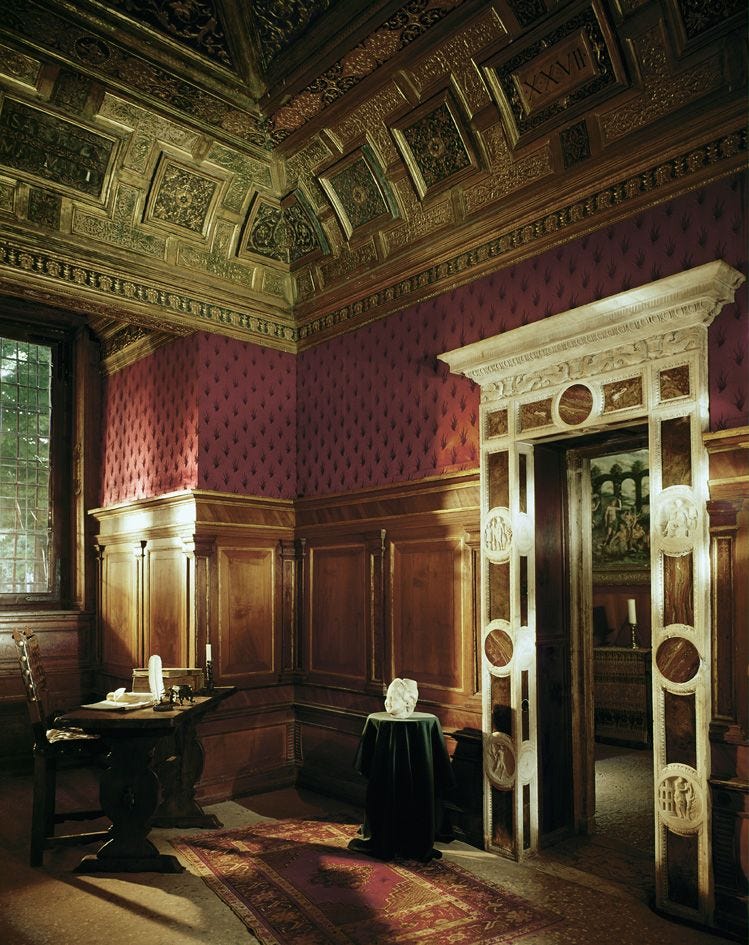
A life as a work of art
Consider what Isabella actually achieved.
She was married at sixteen to Francesco Gonzaga, Marquis of Mantova — a political marriage, as was the custom. She could have lived as most noble women did: managing a household, bearing heirs, hosting events. Instead, she transformed the court of Mantova into one of the most brilliant cultural centers in Italy.
She became the most famous art patron of the Renaissance — commissioning works from Mantegna, Perugino, Costa, and Correggio. She collected antiquities with a connoisseur’s eye that rivaled — and often outmaneuvered — that of the greatest collectors of her age. She built and designed her famous studiolo and grotta — private rooms of extraordinary beauty that she curated as personal sanctuaries for study, reflection, and the cultivation of her inner life.
But she was far more than a patron of the arts. When her husband was captured in battle, Isabella governed the state of Mantova with such competence that she was hailed as a devoted head of state. She studied architecture, agriculture, and industry to improve the wellbeing of her subjects. She navigated the treacherous politics of Renaissance Italy — where popes, kings, and mercenaries competed for power — with a shrewdness that earned the respect of Machiavelli himself.
She was beautiful, charming, and of singular intelligence. But what made her a timeless myth — glorified in her day as much as in ours — was something deeper than intelligence or beauty alone. It was the deliberateness with which she lived. The awareness she brought to every choice. The conviction that the design of one’s environment, one’s surroundings, one’s life, was not a trivial matter — but the most important work a person could undertake.
Isabella understood that when you align your outer world with your inner truth, you become unstoppable.
What she knew that we’ve forgotten
Here is what strikes me most about Isabella d’Este, five centuries later.
She lived in an era without Instagram, without trend reports, without Pinterest boards. There was no algorithm telling her what beauty should look like. No influencer dictating what was in or out. No fast furniture, no disposable aesthetics, no culture of “refresh and replace.”
And yet — or perhaps because of this — she understood something about beauty and self-determination that our era has almost completely lost.
She understood that beauty is not about taste. It is about truth. It is about creating an environment — a home, a room, a life — that reflects who you actually are, not who you are told to be.
She understood that this kind of beauty is not passive. It is not something you observe. It is something you cultivate, deliberately, as a practice. And when you do, it raises your energy. It clarifies your thinking. It connects you to something larger than yourself.
She understood that the home is not a backdrop. It is an instrument. The most intimate space you inhabit — the one that shapes you every day, whether you realize it or not.
And she understood that when you design your life with this level of intention — when every choice carries purpose, when nothing is left to accident or trend — something extraordinary happens. You stop reacting to the world and start creating it.
That is self-determination. And Isabella d’Este may be its greatest example.
Why she matters to me
I first encountered Isabella d’Este when I was a young architecture student in Venice. I was studying the power of constructed space — how color, form, and material can shape perception and influence behavior — while simultaneously pursuing a personal research into ancient systems of self-knowledge that had been passed down for centuries.
When I learned about Isabella, something clicked. Here was a woman who had united exactly what I was trying to unite: the power of beauty, the depth of ancient wisdom, and the practical art of design — in the service of a single goal: living a life of alignment, purpose, and evolution.
She became my role model. Not because I want to be a Renaissance marchioness — but because she proved something I believe with every fiber of my being: that when your outer world is deliberately designed to match your inner truth, you unlock a power that most people never access.
That conviction is the foundation of everything I do with EVA Society. And Isabella d’Este is the reason I know it works.
She did it five hundred years ago. Without science to explain it. Without technology to support it. She did it with awareness, with intention, and with an unwavering commitment to beauty as a path to self-determination.
The question is: what tools did she use? How did she access this knowledge? Where did it come from?
That is a story for another time.
Deliberate Beauty is a weekly newsletter about home, beauty, and becoming. Written by Fabrizia Zorzenon, architect, PhD researcher, and founder of EVA Society.
If this resonated, share it with someone who needs to hear it. And if you want to know what Isabella’s secret was — subscribe. That story is coming.